Coming in at number 89 on our list of the top one hundred ever sports stars is Shirley Strickland.
Why? She has won more Olympic Medals than any other Australian athlete – which seems to us like a good enough reason.
Shirley was born, a farm girl, in 1925 – the second oldest of dive children. The town of Pithara in Western Australia’s wheat belt had no idea of the talent they were about to nurture.
Yet she had pedigree: her father, Dave, has been an athlete: the only thing that had stopped him from taking part in the 1900 Olympics in Paris was the distance and the money that would have had to be spent to get him there.
Shirley would set the record straight for her family - and for Australia too.
Living on an isolated farm, Shirley Strickland received her early education by correspondence – but she did later go on to attend the Northam High School. It was here that her promise as an athlete was first recognised – she won all but two of the 49 events that she entered while she was studying there.
The University of Western Australia was her next stop – she graduated from there in 1946 and wnt on to lecture in physics and mathematics at Perth Technical College. While there she was the wing in the hockey team but what really marked her out was her ability as a hurdler and sprinter. The former world professional sprint champion, Austin Robertson, coached her during her time at Perth.
As a result her 100m yards time went from 11.8 to 11 and she went on to win four Western Australian titles in 1947 – throwing in the shot put as a casual fifth. It was time to take things seriously.
In 1948 she took the national title in the 80m. That gave her a ticket to the first post Second World War Summer Olympics in London where she competed in the 100m, 80m hurdles and took part in the 4x100 relay. She came third in her solo events, taking silver with the team in the relay.
The British Empire was on the wane but that did not stop her from taking three gold medals at the Games in 1950. Following this up, she participated in the 1950 Helsinki games where a gold medal in the 80m hurdles beckoned – a world record time of 10.9 seconds. She also collected silver and bronze in the 4x100m relay and the 100m hurdles.
Another world record was beaten in 1955 where she was times at 11.3 seconds for the 100m hurdles. The Olympics of 1956 on home territory in Melbourne brought gold in both the 80m hurdles and the 4.100m relay.
Following her athletic career she became fully involved with athlete administration in the Olympic movement and participated in this role in the 1968 and 1976 Olympics in Mexico and Canada. She was one of the torch bearers at the opening ceremony of the Summer Olympic Games in Sydney, Australia in 2000.
The following year she gained some notoriety when she sold off all her memorabilia, including her Olympic medals. The collection was acquired by the MCG Museum in Melbourne, purchased but a group of business people who remained anonymous but who, like Shirley, wished to see her outstanding collection remain in Australia.
On 2 May 1969 a newborn child’s cries rang out in Santa Cruz, Trinidad and Tobago. Not an unusual event in itself but if the parents of the child, christened Brian Charles Lara, could see what was in the future for their son their pride at his birth would have been doubled.
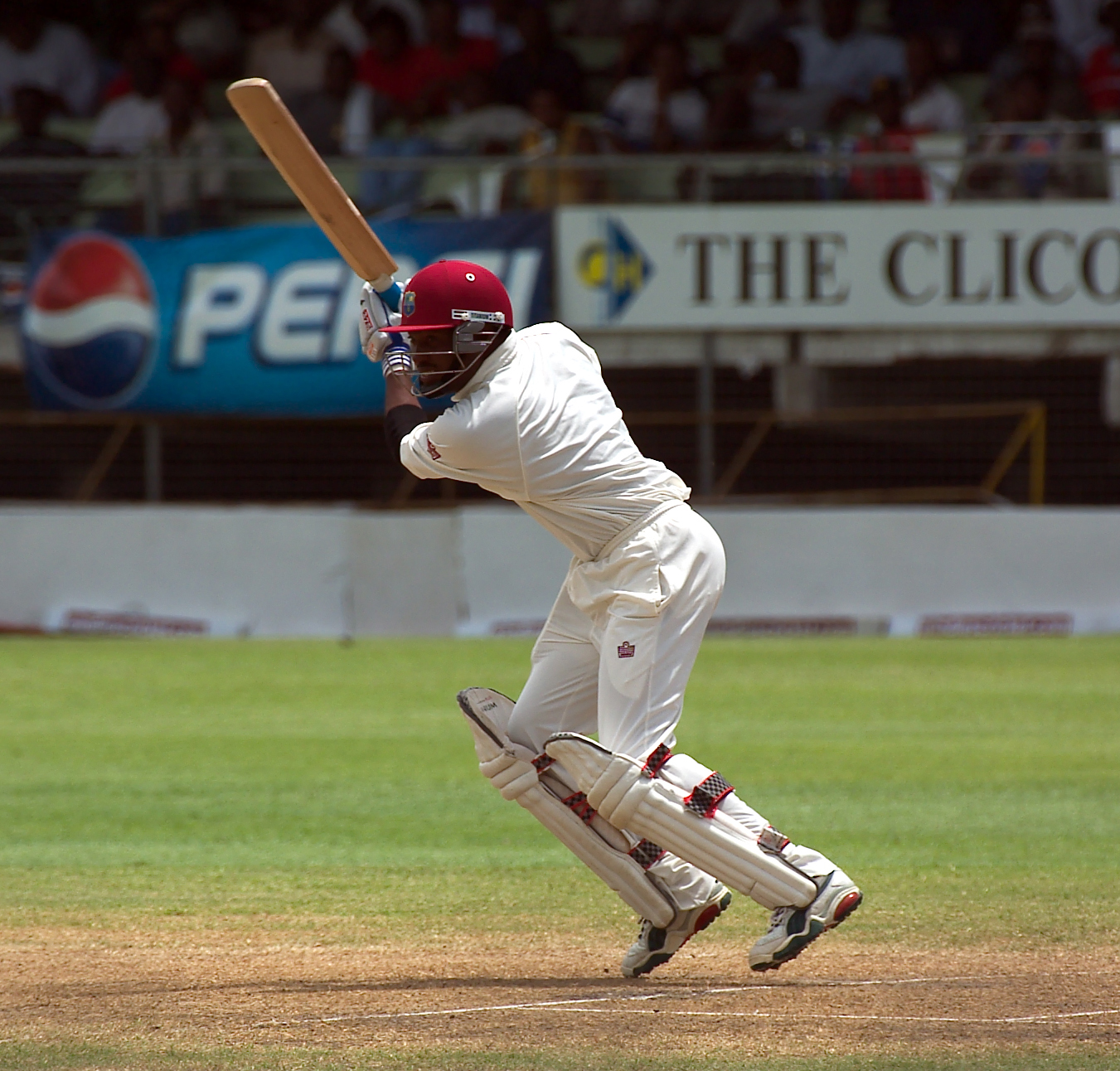
He grew up to be one of the most celebrated cricketers of all time, topping the Test batting rankings a number of times and seizing and holding several records, including the highest individual score in first-class cricket. On that occasion in 1994 he scored an amazing 501 not out for Warwickshire. His dumbfounded opponents, Durham had to simply look on as he scored the first and only quintuple hundred in the history of first-class cricketing.
It was little surprise that as that famous day wore on fans rushed to the ground at Edgbaston to witness history being made.
He also is the holder of the record for the highest individual score in a test innings. This time he was playing against England at Antigua. The celebrated day saw him score 400 not out. Over the course of his career he scored many hundreds, but is the only batsman to do that and score a double century, a triple, a quadruple and a quintuple over the course of his career.
To add to all this, in a single over in South Africa in 2003 he scored 28 runs off Robin Peterson of South Africa. Put simply, the man was unstoppable.
Lara has his family, perhaps, to thanks for his cricketing success. As the tenth of eleven children it would not surprise many if the parents didn’t watch their second to last offspring too often, with so many in the family. Yet it was his sharp eyed father, Bunty and Agnes his older sister who spotted his potential at the age of six and enrolled him in the Harvard Coaching Clinic.
As such, Lara’s early exposure to correct batting techniques would stay with him and be developed over his lifetime. When he was a teenager he was in teams in the Trinidad schoolboy’s league. He caught the eye of the national under 16 team when his average in the league was an amazing 126 per innings, not to mention his tally of 745 runs in the league.
At the age of fifteen he played his first West Indian under 19 tournaments and the same year saw him represent his country for the first time. His heroes, Gordon Greenidge, Viv Richards and Roy Fredericks were soon to have company in that special league of their own.
1987 was a memorable year as Lara scored 498 runs in the West Indies Youth Championships – the first record of many that he was to break. The following year he made his debut for Trinidad and Tobago and scored 98 in his second first-class match. The same year saw him captain the West Indies in the Bicentennial Youth World Cup. Lara was on his way.
The following year his great opportunity presented itself – he was selected for the West Indies team (rather than the youth team) but this coincided with tragedy. His father, Bunty, died and Lara withdrew, coming back the year after to captain the B Team in Zimbabwe.
He was not to be held back again. In 1990 at the age of twenty he became the youngest ever man to captain Trinidad and Tobago. He also made his debut for the West Indies.
In 1993 his International career truly got underway when he scored 277 against Australia – his maiden test century. His efforts proved to be the turning point for the West Indies as they then went on to win the final two tests – and the series 2-1.
To commemorate this, Lara would name his first daughter after the city in which he had achieved this – Sydney.
In 1995 Lara was made Man of the Series in the test match against England. He captained the West Indies from 98 to 99 won Man of the Match against Australia as well as Man of the Series in the famous Four Test Series of 1999.
Lara was reappointed as captain against the touring Australians in 2003, and struck 110 in his first Test match back in charge, showing a return to stellar performance. Later that season, under his captaincy, West Indies won the two match Test series against Sri Lanka 1-0 with Lara making a double century in the First Test. In September 2004, West Indies won the ICC Champions Trophy in England under his captaincy.
He returned again to the captaincy of the West Indies in 2006 and led the team to victories against Zimbabwe and India. In the same year he became the first player in the team to ever pass the 10,000 run mark. He retired from international cricket in the following year.
Unable to resist it, he played again for Trinidad against Guyana – which they won. Lara’s cricket career is still happening today but what it holds for him is unsure. Whatever happens he will certainly go down in history as one of the best cricketers of all time.
World in Sport is a new website written by fans for fans. We are looking for writers for the site.
Why write for us?
We are a new website, so you can be in there at the beginning! We intend to make a real go of this, so instead of joining late you can get to this match on time!
You may want to write about sports online with a view of building up a portfolio of work with which to impress people.
You could be starting out in sports journalism and looking for a niche. You may want to do this for the Résumé, to help university applications or just for the sheer hell of it. Whatever your reason, we welcome your contributions.
Whatever the reason, please contact us.
We are looking for some keen writers to write about any aspect of sport they want to- matches, teams, and personalities - anything at all really as long as it is on sport! You may just want to do a weekly review of your own team’s matches – great! You may want to profile a sportsman or woman. Anything goes here as long as it is original writing.
You will get full credit and after you have written a few articles we would hope to give you full posting rights so you can put your news and views online yourself. Plus we will tag your name in to all your posts so you will be quickly able to show anyone all the articles you have written for the site in one long stream.
You do not need to be the new Shakespeare - we will edit your stories to iron out any errors. We are simply looking for people with a passion for the game and an urge to write about it.
Let us know if you are interested - and let's get writing!
The four minute mile was an elusive ambition in the field of athletics. It had been a target for many years but has never been recorded formally.
Then one day in 1954 a young man by the name of Roger Gilbert Bannister was the first person to cross this important barrier. It was a symbol of humanity’s ability to improve upon itself and he was there first. For years it had been thought an impossible barrier.
Roger Bannister was born in 1929 (and is still going strong to this day) in Harrow, a small town outside of London famous for its private boy’s school.
Bannister, however went to City of Bath Boys’ School before going on to study at University at Oxford University, followed by a tenure at St Mary’s Hospital Medical School which now forms part of Imperial in London. Little did he know then that a movie would be made about his life one day.
Like many British gentleman of his day, Bannister’s start in the world of athletics was decidedly amateur – and this is not meant in a derogatory way, At 17 he had gone down to Oxford, a promising medical career lying ahead of him. Running was a serious hobby – so the young Bannister had for example never worn running spikes before that time or indeed run on a track.
Even by the standards of 1946 his training was light. Yet he showed an enormous amount of promise and the following year he ran a mile in 4:26:6. This was with just a half hour training session three times a week. Yet why was the mile such a target, such a dream? This video, although not directly about Bannister, goes a long way to explain its allure to athletes - even today.
The British Olympics Committee was certainly impressed and he was selected as a possible in 1948. The still teenage Bannister graciously declined. He felt that he was not ready for the Olympics, choosing instead to watch them.
Over the next few years he steadily improved his timing at both the mile and the 800m (run in European Championships where a defeat in 1950 spurred him on to train much more vigorously than ever before).
His reputation of invincibility grew (mostly at home in the UK, of course) but this came crashing down in the European Championships at Belgrade in 1951 on 25 August, He lost to the Yugoslav Andrija Otenhajmer – at 3:48:4 in the 1500m. It was only 1:4 behind the other runner but it was, nevertheless, a blow.
The 1952 Olympics saw a further blow where he came fourth in the 1500m final. Yet hope remained – he had at least set a British record of 3:46.30 (3:46.0) in the process.
Bannister spent several months dwelling on his defeat and deciding whether to stay with running or to give it up entirely. After all, he had his medical career to consider and athletics made a fraction of the money that it does today. He eventually shrugged off the idea of throwing in the towel and instead set himself a new target – to be the first man to run a mile under four minutes.
He trained incredibly hard and in 1953 he made an attempt at the British record, previously held by Sydney Wooderson at 4:04.2 who had created the record eight years previously. Bannister came in at 4:03:6 – shattering the record and instilling a new hope in himself – he knew now that the four-minute mile was not out of reach.
It was not as if he didn’t have competition. Other runners had their eye on the prize too. The American Wes Santee came close on 5 June 1953 with a time of 4:02:4. Then there was the Australian John Landy who ran 4:02:0 in December of the same year. He followed this up with several new attempts in the early months of 1954 but narrowly failed to better his time.
Bannister had nervously followed his Australian rival, convinced that at each attempt the four-minute mile would be broken. At the end of the Australian season in April Bannister knew that he had a short window of opportunity – his own attempt at the record had to come soon.
The date was chosen. It would be 6 May 1954 at a meet between the British AAA and Oxford University. The Iffley Road Track in Oxford was duly prepared and 3,000 spectators turned up in anticipation. Yet the day turned out to be windswept – a 25 mile per hour wind was blowing around the track. Bannister all but pulled out but then, just before the race was due to start the winds – as if by divine ordinance, dropped. The race would go ahead.
Brasher and Chataway, running colleague had already agreed to provide the pacing for Bannister. Harold Abrahams (immortalised by his own career and the film Chariots of Fire) was there to do the commentary for the BBC Radio. Norris McWhirter who would later in his life edit and publish The Guiness Book of Records with his twin brother Ross was the stadium announcer. It was an all star cast, as it were.
Here is the race, with Roger Bannister narrating, explaining his feelings as one of the pivotal sporting events of the century progressed.
McWhirter was something of a showman. Once the race was run he teased the audience with a long preamble to the hotly anticipated result.
"Ladies and gentlemen, here is the result of event 9, the one mile: 1st, No. 41, R.G. Bannister, Amateur Athletic Association and formerly of Exeter and Merton Colleges, Oxford, with a time which is a new meeting and track record, and which - subject to ratification - will be a new English Native, British National, All-Comers, European, British Empire and World Record. The time was 3..."
There was no point at the stage in continuing. As soon as the stadium heard the magic word – 3 – it erupted with a deafening roar of triumph. Bannister's time was 3:59.04 and it was indeed a new World Record.
Of course this spurred on athletes all over the globe and it was less than two months later (46 days to be precise) that Bannister’s own record was broken. This time it was his rival, the Australian John Landy who ran 3:57:9 in Finland.
Bannister and Landy were to finally compete against each other, post record, on 7 August 1954 at the Commonwealth Games in Canada. Bannister won this epic clash of the titans, coming in at 3:58:8 with Landy less than a second behind him. Roger Bannister went on to gain a European Championship record for the metic mile (the 1500m) at Bern on 29 August – his time there was 3:43:8. Here is their miracle mile.
If it was today, Bannister would have been made for life with sponsorship deals and so on. However, for athlets 1954 was another world – if not universe and these options were simply unthought-of at that point. After Bern, Roger Bannister announced his retirement from athletics. He returned to his role as a junior doctor and pursued a successful career in neurology.
Anyone for cricket? Number 91 on our list of the top 100 sports stars is Adam Gilchrist, who otherwise goes by the nicknames of Church or Gilly. He is the first but not the last cricketer to appear but this guy is not yet retired from the game and has redefined the role of the Australian national cricket team.
Born in 1971, Glichrist is an attacking left-handed batsman but it is for his wicket keeping that he holds world records. He is the current holder of the record for the most dismissals by a wicket keeper by an Australian in test cricket and in One Day Internationals. He is generally thought to be one of the best ever wicket-keeper-batsman combinations in the history of the sport of cricket.
There is more – he is the only player ever to have hit 100 (that’s ONE HUNDRED) sixes in Test Cricket. Not only that, he has 17 Test centuries under his belt as well as 16 ODIs. As a player who was destined to be primarily a wicket keeper, that is some achievement.
He also has a unique record – the only player ever to score a minimum of fifty runs in successive World Cup finals (99, 03 and 07) and has actually won three titles – one of only three players to do so.
At the age of 17, Adam Gilchrist spent a summer with Richmond Cricket Club in London. He performed so well that he was interviewed by the regional BBC Sports Reporter, Michael Wale.
He has sometimes gone against the grain of the establishment in as much as he is a self-confessed walker. That is, occasionally he disagrees with the umpire, who says he is in – and walks off! Fair is fair, however, a player is more likely to know when they are out than the umpire yet many would make the contrary decision. Not so Gilchrist.
His first class debut was in 1992 and his first ODI (One Day International) debut followed four years later, with his Test debut in 99. He has played for his home nation in 96 test matches and getting on for 300 ODIs. In both forms he was Australia’s Vice-captain and captained the team when the regular captains were unavailable.
Here is Adam Gilchrist smashing a century in 57 balls in the Ashes 3rd test. He is the second fastest behind Viv Richards.
Although he has now retired from International cricket he still plays for the Indian Premier League with the Deccan Chargers. He was made captain in 2009 and led the team to the Twenty20 title in the same year.
It was his style of attack batting that was key to Australia’s ODI successes when he was a member of the team, and as such it was Gilchrist who invariably opened the batting. For a wicket keeper his batting average is more than reasonable – in the upper 40s in tests with a Test strike rate of 82 runs for every 100 balls and he is renowned for batting shots to every area of the field in a dynamic and consistent manner.
Outside of the sport Gilchrist serves as an ambassador for the World Vision charity in India – a country in which he is immensely popular.
Two time Olympic gold medallist Shaun Roger White had things stacked against him in his early years. Before he was even one year old he underwent two open-heart operations to deal with a heart defect known as a Tetralogy of Fallot. As a dual sportsman in the field of both snowboarding and skateboarding he comes in at number 93 on our list of the 100 greatest sports stars.
And a star he certainly is. The best of the best in his sports fields, White spent his early years in and around the ski resorts of Southern California and some argue that he is immediately identifiable with the state both in terms of his heritage and his overall look.
At 1.73 meters tall he may not be the tallest snowboarder ever but he is certainly the best – something that can occasionally be judged by the amount of nick names a sports star picks up during their career.
He has had several – the most notable being The Flying Tomato, of which he tired (and who wouldn’t) but not without wearing a read bandana for a number of years. If you are old enough to remember The Muppet Show you will instantly recognise his second – Animal!
Let's take a look at him in action at the pipe finals at Burton Open New Zealand 2009.
Like other sports stars on this list White’s dual career took place at the same time. His skateboard career went hand in hand with his rise through the snowboarding ranks. He was spotted by a professional skateboarder, Tony Hawk, at the age of nine: Hawk saw his potential immediately and mentored him for a number of years, eventually helping him turn professional at the young age of seventeen.
Here is Shaun White snowboarding at the age of ten.
While winning coveted titles such as the Action Sports Tour Champion and the Summer and Winter X Games, White’s interest in snowboarding burgeoned. In fact he had taken up the sport two years before skateboarding, at the age of six (before which he had been a skier!). By the time he was seven he was already signing sponsorship deals.
Below, White talks about combining both careers (from 2008).
Born in 1986, White was twenty when he represented the USA at the 2006 Winter Olympics where he won the gold in the snowboard pipe event, repeating this achievement four years later. He has also won a medal at every Winter X Games since 2002, giving him a total of 2 bronze, 3 silver and an amazing 10 gold.
The 2006 Winter Olympics was a touch and go affair. The first run saw White score a meagre 37.7 and it looked as if he was heading out of the competition. However, his second run saw his score shoot up to 45.3. He bettered this in the finals, with a score of 46.8, beating the nearest other snowboarder by 2.8 points. Considering the maximum score is 450 this was some achievement.
His third consecutive US Open Snowboarding Championship title came in 2008 as did his third US Open slopestyle competition. Although there is not as much money to be made in the sport as, say, soccer, White managed to take $210,000 at the 2007 Open – plus a brand new Corvette. He diversified away from straightforward sponsorship in 2008 when he released his first video game (see above), Shaun White Snowboarding.
Although we do not have figures for income generated it was the 20th best selling game in the Christmas market of that year in the enormous American market. You do not need to do the math to realise that it is quite a lot of money. He also appeared on the cover of Rolling Stone Magazine.
At the same time, White does not neglect his skateboarding career. Here he is in action in September 2010.
In 2009 he competed in the FIS World Men’s Halfpipe event at Cypress Mountain and managed in his finals run to achieve the highest ever FIS halfpipe score – a remarkable 47.3. He followed this up with a gold in the Halfpipe at the Winter Olympics (Vancouver) in the following year, securing the gold medal on his first run.
Without the need he decided to do the second run anyway – as a kind of victory lap. Ending with a Double McTwist 1260 (which he calls The Tomohawk) he was given a score of 48.4. No one can score 50 at snowboarding – but is there any need to guess what the highest score possible is. Right – 48.4. Here is the action.
No doubt, we haven’t heard the last of Shaun White yet. At number 93 on our list of the 100 greatest sports stars it seems almost inevitable that he will rise further up the chart in the years to come.
Back in March Wayne Rooney was interviewed by the Guardian newspaper in the UK. “The England squad must be better role models”, said the Manchester United star. He went on to add. "It is difficult as a footballer because you know people look up to you. You are role models whether you like it or not.” He also added, not without irony now that footballers had to “try to do things well for kids to see.”
The Guardian article was written well before the England striker’s latest scandal, but it does show that he is aware of the fact that he is a role model, as are his fellow England team mates. Yet how far has he strayed from his own ideals? Is he still an acceptable role model for our children?
Wayne Rooney is (or perhaps was) a role model to many people, for various reasons around the globe. Should he have taken more care with his actions due to the fact he is such a major role model, or should he just live life how he wants to?
The public are not really asking for anything much from him or other any other sports stars for that matter, just professionalism. When a player such as Rooney is in the news many people tend to follow it. This number would of course include the easily impressionable members of society, like children.
When children see their idols in the press and on the TV, they pay attention so if their idol is encouraging a positive action like telling them to work hard at school they may be inclined to do so. But on the downside they can also see how their role models can make bad decisions, those actions can affect them just as much.
At times it can be quite worrying how little privacy our nation’s stars get, and it could be argued that sooner or later they are bound to get caught doing something immorally indefensible as many people have judged Rooney’s recent contract actions to be. However while this show that they are only human after all, does a huge salary mean that sports people like Rooney have to be beyond reproach at all time?
With a world so fixated on its celebrities, social networking has become a major pratfall for the famous with sites such as Twitter and Facebook feeding the world a never ending stream of tittle tattle and gossip.
It may be that a good role model is a thing of the past or at the very least a much harder thing to come by.
Australia, it cannot be doubted, has produced many world class sports stars, per capita possibly more than any other country in the world. That and the little green god aside we have to take our hats off to number 95 on our lists of the 100 greatest sports stars ever – possibly the greatest sportswoman that Australia has ever produced. Yet why, we wonder, have so few people ever heard of the incomparable Heather McKay?
It could be the fact that her sport was squash (she is not retired): for whatever reasons the sport has not joined the likes of golf and tennis in the megabucks or for that matter mega interest stakes. It could be, also (and we say this shamefully) that in an oft overlooked sport the female players are generally ignored even more than the male. Whatever the case, it remains that Heather McKay has one of the most outstanding sports records that you will ever hear about.
Domination isn’t quite the word for what she represented in the squash world. She was the ultimate squash player of the 60s and 70s and won 16 British Open titles in a row between 62 and 77. She also won the World Open title when it began in 1979. During this period she was never defeated. Not once. Never. Hats off to Heather! How many other sports stars have that sort of record? Yes, we couldn’t either.
What was more she also played racquetball and field hockey at top levels. Born in 1941 McKay was defeated only twice in her career (once in 60 and again in 62). When she retired in 1981 she had not been beaten since that day in 1962. Her first British Open came at the age of 21 and then there was almost a generation of comfortable wins. In 1968 she won the final against Bev Johnson (also an Australian) without conceding a single point.
Retiring at the age of 40 from top-level squash she has remained active in the Masters Level events, winning two over-45 and two over-50 World Championships. To cap it all she was a member of the Australian Women’s Hockey Team and won the American (Amateur) Racquetball Championship in 1979. Moreover she won the professional version of that title three times (80, 81 and 84) as well as winning the Canadian Racquetball Championship five times.
Some amazing facts about an amazing sportswoman. Although little known outside of her arena, are you surprised any longer to find here on this top 100 sports stars list?
The first African-American World Heavyweight Boxing Champion whose win provoked a race riot.
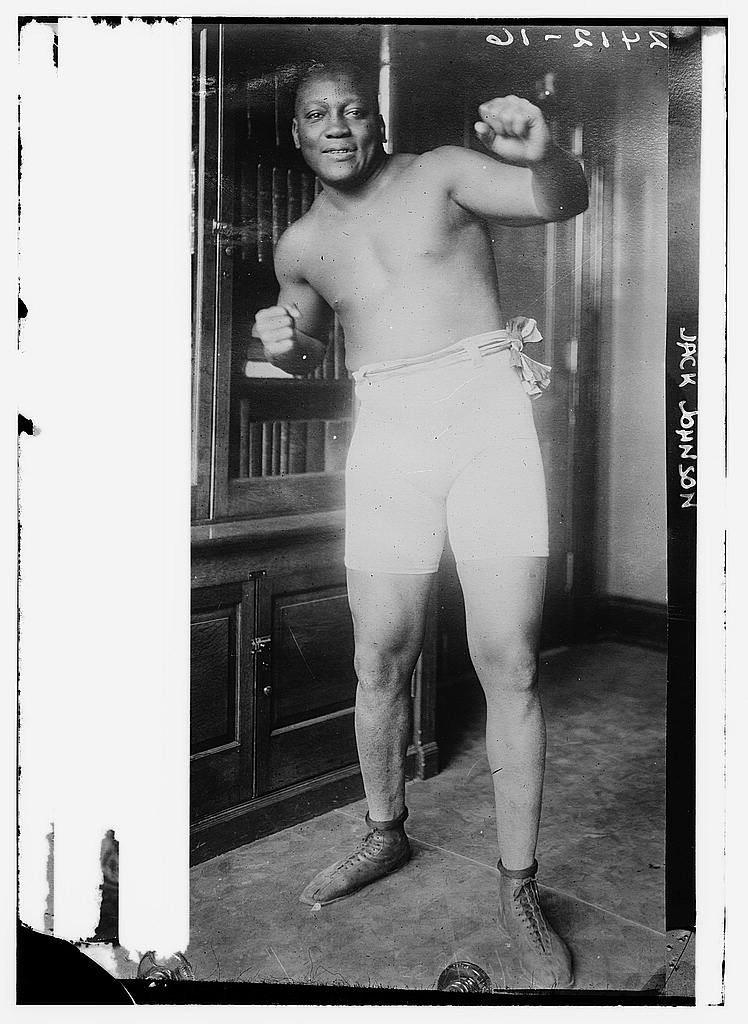
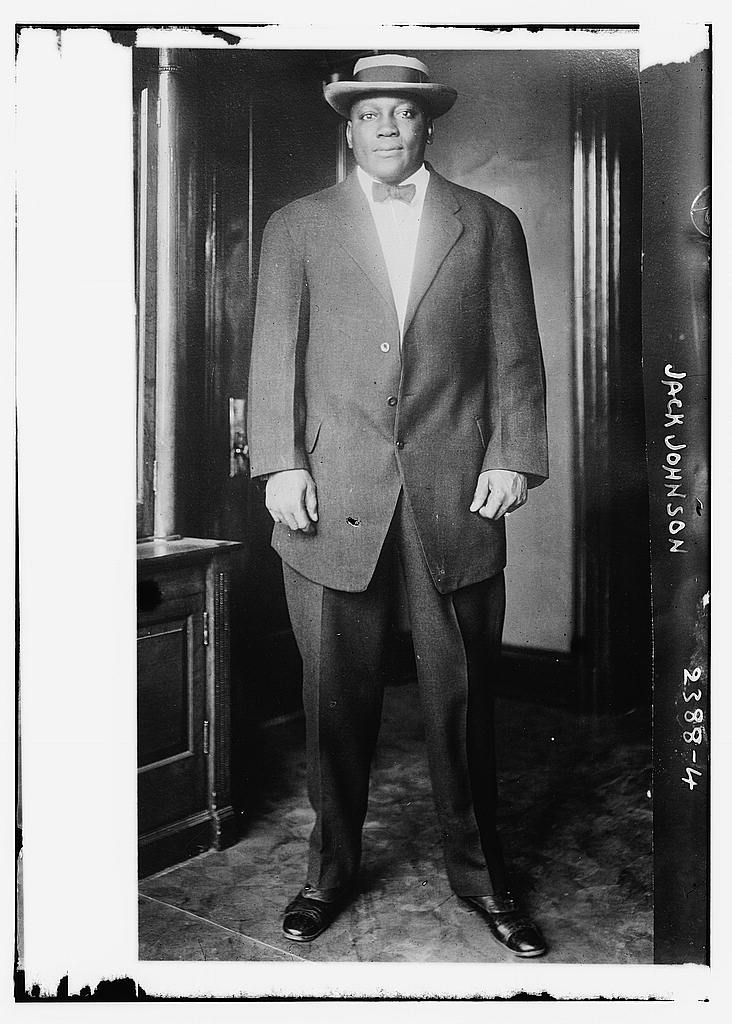
Way before Cassius Clay (later to be Muhammad Ali) was even a twinkle in his father’s eye an African American took the World Heavyweight Boxing Champion, the first African American to do so. The year was 1908 and Jack Johnson (born John Arthur Johnson) held the title for seven years. Many people have never heard of Jack Johnson, but his story is one which needs (or indeed begs) to be told.
His story also enables us to reflect on how much times have changed in so many ways – and yet in others hardly at all.
Johnson was born to Henry and Tina Johnson in Galveston, Texas in 1878. His parents were emancipated slaves and Henry, their first son was represented the first generation of his family to be born in to freedom. Yet times were tough. Although the parents worked a succession of blue-collar jobs yet still managed to teach their six children to read and write. Galveston only had about five years of formal education before he joined the tough world of the Galveston Docks as a general laborer.
Johnson developed his boxing technique in this environment, patient and defensive, he would lie in wait for his opponent to make a mistake and then he would go in for the kill. A cautious starter he would build up his aggression over a series of rounds and then continuously punish his opponents rather than go all out for a knockout blow.
The press of the day rounded on Johnson for his technique. Yet only a decade earlier they had praised “Gentleman” Jim Corbett, generally considered the father of modern boxing, for a very similar style. Johnson had studies the techniques of the 1892 World Boxing Champion and adapted them to his own style. Yet still the press condemned him for being devious. Clever and color it seemed, would not be rewarded.
By the turn of the new twentieth century Johnson had dozens of wins against both black and white fighters.
His first title would come in 1903 – when he won a title that no one would contemplate these days – the World Colored Heavyweight Championship. Perhaps he could have won the World at that time but the champion of the time, James J Jeffries simply refused to fight him – on purely racially grounds.
Today, this would probably mean the end of someone’s boxing career and international vilification in the press. However in 1903 Jeffries was well within his rights. Other championships were open to black boxers but the world title was blocked, completely off limits. Not to be thwarted, in 1907 Johnson proved his mettle when he knocked out a former World Heavyweight Champion in the second round.
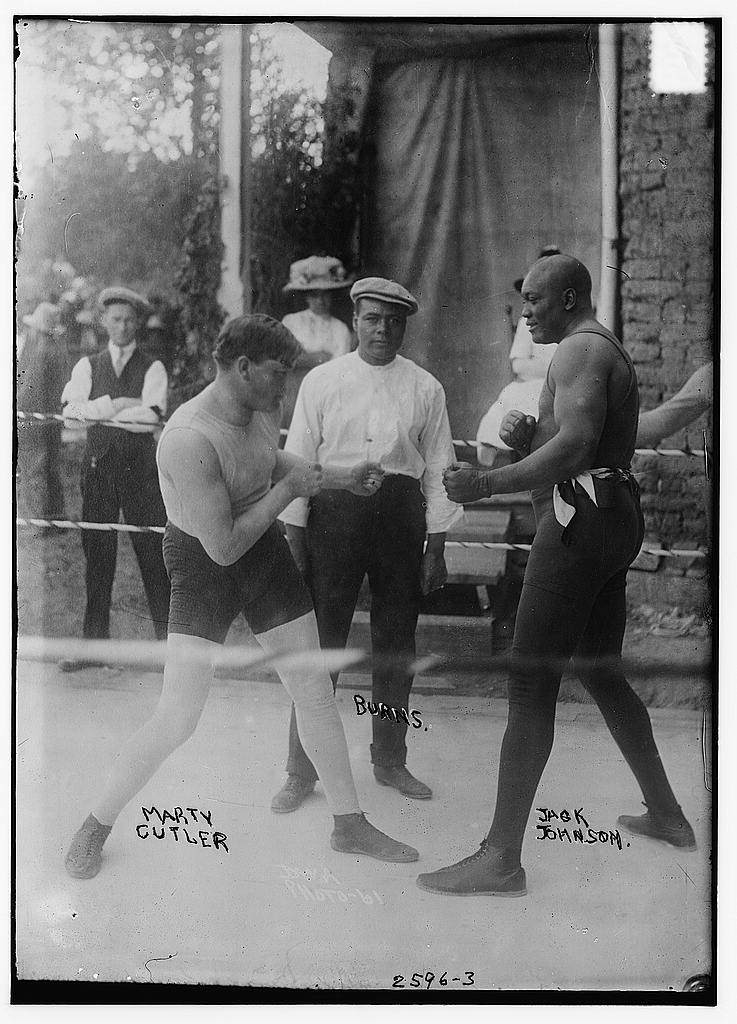
Johnson used a tactic familiar to us today in order to secure a match. He virtually stalked the world champion (the Canadian Tommy Burns) around the world and used the press (his old enemy) to taunt the boxer in to finally agreeing to fight him. Burns finally gave in and on Boxing Day 1908 the pair went head to head for fourteen rounds in front of over twenty thousand people in Sydney, Australia (see picture below). It was stopped by the police and the referee awarded the title to Johnson.
The referee deemed the win to be a Technical Knock Out (TKO) deeming Burns unable to continue. However, Johnson had clearly won the fight, having soundly beaten the champion particularly in the later rounds. The technicality must have made him furious but he had what he wanted – the Heavyweight Championship of the World.
There was an immediate and racial backlash towards Johnson in the press, who had happily printed his goads towards Burns but had not expected him to win. Jack London (who wrote Call of the Wild) was one of many who called for a Great White Hope to come along and beat Johnson. And so they did – many of them in exhibition matches.
While champion, Johnson lived the life of a celebrity and was forever in the press or on the radio. He was immensely popular - above, a crowd await his arrival in New York sometime between 1910 and 1915 (his poster appears bottom left).
He endorsed a great number of products and became a hobbyist, joining in the new fad for automobile racing. He was always immaculately and expensively tailored - and had a fine line in nouveau riche wit. When stopped once for speeding he gave the traffic cop a one hundred dollar note. The fine was fifty and the policeman protested that he had no change to give. Keep it, rejoined Johnson – I intend to make my return trip at the same speed.
The day Johnson – and the world – would never forget came in 1910. The former champion, James J Jeffries (who had never been defeated during his career) came out of retirement. He was quoted in the press as saying “I should step into the ring again and demonstrate that a white man is king of them all.” He had been out of fighting for six years and was not at peak fitness by any means. You can guess the outcome.
The fight was arranged on a deliberately provocative date – July 4 – and was fought in Reno, Nevada in front of a capacity crowd of twenty thousand. Fifteen rounds later Jeffries’ team called it quits – Johnson had knocked him down twice already (a career first for Jeffries) and they did not want the black champion to knock him out. Here are the highlights.
Johnson retained his title and earned (for those days) an enormous $65,000. Yet the result of the fight was to have untold consequences. His retention of the title provoked race riots in more than 25 states and 50 cities, all on the fourth of July. Humiliated by his victory whites took the law in to their own hands and police had to stop several attempts at lynching.
Most of the riots began as black communities celebrated in the streets and the police and neighboring white retaliated through sheer spite. Chicago police, notably, allowed the celebrations to continue peacefully and the African-American poet William Waring Cuney was inspired to write My Lord, What a Morning. It is short, pointed and very funny.
O my Lord
What a morning,
O my Lord,
What a feeling,
When Jack Johnson
Turned Jim Jeffries'
Snow-white face
to the ceiling.
Johnson kept the title till 1915, when he lost it to Jess Willard, a Kansas cowbot. It went on for an amazing 26 rounds and ended with Johnson KO’d. By this point Johnson was 37 and past his peak. Yet Johnson’s name will live on forever in boxing history forever.
In 1920 Johnson opened a club in Harlem. After three years he tired of it and sold it to a notorious gangster, Owney Madden. Madden reopened it as The Cotton Club.
Johnson died in 1946 in a car crash near Franklington, North Carolina. He was 68. He had lost his temper in a local diner, had rushed out and got in his car – and ultimately lost his life in the crash. Why had he rushed so angrily out of the diner? They had refused to serve him – on the grounds of his color.
Jonah Lomu, (MNZM) is a New Zealand rugby union player. He had sixty-three caps as an All Black after debuting in 1994. He is generally regarded as the first true global superstar of rugby union. One of the sport's most intimidating players on the field, he has had a huge impact on the game. He was inducted into the International Rugby Hall of Fame on 9 October 2007.
Jonah Lomu All Blacks Legend:
Trivia about Lomu:
Jonah turned down a multi-million dollar offer to play American football.
Jonah is a giant New Zealand rugby player regarded as one of the world's best players ever. Bizarrely, Jonah plays as a winger - a position usually occupied by the lightest and smallest players. On his best form, it can take 4 or more players to bring Jonah down.
He was offered the role of the villain Gabor in the James Bond movie The World Is Not Enough (1999), however, he declined in order to concentrate fully on his rugby career. The role was then given to former Gladiator John Seru (a.k.a. 'Vulcan').
Jonah has a wax likeness of himself at Madame Tussauds in London.
Has the number 11 - which is his famous playing number - tattooed on his muscular chest.
Has his own Playstation game - "Jonah Lomu's Rugby"
He was awarded the M.N.Z.M. (Member of the Order of New Zealand) in the 2007 Queen's Birthday Honors List for his services to Rugby in Auckland, New Zealand.
The worlds greatest:
Lomu burst onto the international rugby scene during the 1994 Hong Kong Sevens tournament and was widely acknowledged to be the top player at the 1995 World Cup in South Africa even though New Zealand lost the championship game to the host Springboks. At one time Lomu was considered 'rugby union's biggest drawcard',swelling attendances at any match where he appeared. He has played for several provincial teams, in the Super Rugby and NPC competitions.
These included the Blues, Chiefs and Hurricanes, and Counties Manukau, Wellington and later North Harbour. He made a comeback after undergoing a kidney transplant in 2004. In 1996 he married South African Tanya Rutter; they officially divorced in 2000. He married Fiona Taylor in 2003 and divorced her in 2008. He is officially the Rugby World Cup all-time top try scorer with 15 tries.
Jonah retired from rugby in 2007, but was persuaded to play in the Help For Heroes charity match at Twickenham a year later, although had to withdraw after injuring his ankle in training.
However, in June 2009, the BBC claimed he was close to joining French third division club Marseille Vitrolles and was expected to start in the first match of the new season.
Roger Federer (born 8 August 1981) is a Swiss professional tennis player who held the number one position for a record 237 consecutive weeks As of 3rd October 2010, he is ranked World No. 3 by the Association of Tennis Professionals (ATP). Many sports analysts, tennis critics, and former and current players consider Federer to be the greatest tennis player of all time.
Roger Federer has won a record of sixteen grand slam titles, the Swiss also holds the record of reaching 10 consecutive Grand Slam finals and appeared in 18 of 19 over four and a half years from the 2005 Wimbledon Championships through the 2010 Australian Open, excluding the 2008 Australian Open. Federer has won 4 ATP World Tour Finals and 17 ATP Masters Series tournaments. He also won the Olympic Gold Medal in doubles with his compatriot Stanislas Wawrinka at the 2008 Summer Olympic Games.
Roger Federer on winning sixteen grand slam titles:
The lady whose graceful postered form plastered the bedroom walls of many a teenage boy back in the 1970s, Chris Evert is a former World Number 1 tennis player. From the US, she won an incredible eighteen Grand Slam singles championships. She holds a number of records, too - six wins at the US Open and a Magnificent Seven at the French Open. She was the world number one in at least five years (75 -- 77, 80-81) and according to some people she should have that title for 74 and 78 in to the bargain. As such, she makes number 97 on our list of the 100 Greatest Sports Stars - Ever!
Young Christine Marie (later to be called Chris) was born on December 21 1954 and comes from notable tennis lineage. Her father was Jimmy Evert who by the time Chris was born was a professional tennis coach but who had won the Men's Singles at the Canadian Championships in 1947.
It was inevitable that Chris would chose tennis, then - drag racing was hardly going to be an option in the Evert family home!
In 1971 she made her Grand Slam tournament debut at the ripe old age of 16 - after she had won the national sixteen-and-under tournament.
It was a walk in the park at first - straight sets over Edda Buding. However, she then had a much harder task against the more experienced Mary Ann Eisel and Leslie Hunt. However, she lost out to the then indestructible Billie Jean King. This meant an end to a fantastic 46 match winning streak but she was playing with the big girls now.
1974 was a good year when she won her first Grand Slam singles title (beating her previous winning streak with a remarkable 56 matches unbeaten. As much focus was placed at the time on her relationship with fellow tennis professional Jimmy Connor as her victory - although this particular love match would prove to be a short live one.
She played with him in the mixed doubles finals that year but as her career progresssed Evert spent more time concentrating on her singles career.
Chris Evert wins the 1980 US Claycourt Championships.
Evert dominated the women's game for the next five years, defeating the likes of Evonne Goolagong enough times to secure her place in the annals of tennis as the best female player of that era. She was a very cool player - receiving an ice maiden reputation, but then someone came along who would challenge her composure.
Although good friends off the court it was Martina Navratilova who would prove to be Evert's on court nemesis. Their rivalry on the tennis court would become the stuff of sporting legend and while Evert bested Navratilova (seen together left) during their early encounters, Navratilova would ultimately prove the superior player in the 1980s.
Evert was a great player on all surfaces but it was on clay where she was most at home. From August 1973 she won an unbeaten 125 consecutive matches on clay - and only lost seven sets. This remains to this day a record. Incidentally, this streak was broken by Tracey Austin at the Italian Open in 79. She then went on to win a further 72 matches on clay before Hana Mandlikova beat her in the 81 French Open.
In one of their all-time greatest barn-burners, Chris & Martina went to 7-6 in the 3rd set in the '87 Houston final.
Chris Evert retired from professional tennis in 1989. After all, 157 singles titles was not a bad amount on which to leave - neither were her eight doubles titles.
Even her semi-finals history is staggering - out of the 303 tournaments she entered she got through to the semis in no less than 273 of them.
All in all, Evert won at a minimum of one Grand Slam singles title each year for thirteen consecutive years.
What is Chris Evert doing now? She is currently operating a tennis academy (which bears her name) in the town of Boca Raton in Florida. She also contributes to Tennis magazine.
A tennis legend, she will continue to be one of the role models that young players look up to for many decades to come.