Coming in at number 89 on our list of the top one hundred ever sports stars is Shirley Strickland.
Why? She has won more Olympic Medals than any other Australian athlete – which seems to us like a good enough reason.
Shirley was born, a farm girl, in 1925 – the second oldest of dive children. The town of Pithara in Western Australia’s wheat belt had no idea of the talent they were about to nurture.
Yet she had pedigree: her father, Dave, has been an athlete: the only thing that had stopped him from taking part in the 1900 Olympics in Paris was the distance and the money that would have had to be spent to get him there.
Shirley would set the record straight for her family - and for Australia too.
Living on an isolated farm, Shirley Strickland received her early education by correspondence – but she did later go on to attend the Northam High School. It was here that her promise as an athlete was first recognised – she won all but two of the 49 events that she entered while she was studying there.
The University of Western Australia was her next stop – she graduated from there in 1946 and wnt on to lecture in physics and mathematics at Perth Technical College. While there she was the wing in the hockey team but what really marked her out was her ability as a hurdler and sprinter. The former world professional sprint champion, Austin Robertson, coached her during her time at Perth.
As a result her 100m yards time went from 11.8 to 11 and she went on to win four Western Australian titles in 1947 – throwing in the shot put as a casual fifth. It was time to take things seriously.
In 1948 she took the national title in the 80m. That gave her a ticket to the first post Second World War Summer Olympics in London where she competed in the 100m, 80m hurdles and took part in the 4x100 relay. She came third in her solo events, taking silver with the team in the relay.
The British Empire was on the wane but that did not stop her from taking three gold medals at the Games in 1950. Following this up, she participated in the 1950 Helsinki games where a gold medal in the 80m hurdles beckoned – a world record time of 10.9 seconds. She also collected silver and bronze in the 4x100m relay and the 100m hurdles.
Another world record was beaten in 1955 where she was times at 11.3 seconds for the 100m hurdles. The Olympics of 1956 on home territory in Melbourne brought gold in both the 80m hurdles and the 4.100m relay.
Following her athletic career she became fully involved with athlete administration in the Olympic movement and participated in this role in the 1968 and 1976 Olympics in Mexico and Canada. She was one of the torch bearers at the opening ceremony of the Summer Olympic Games in Sydney, Australia in 2000.
The following year she gained some notoriety when she sold off all her memorabilia, including her Olympic medals. The collection was acquired by the MCG Museum in Melbourne, purchased but a group of business people who remained anonymous but who, like Shirley, wished to see her outstanding collection remain in Australia.
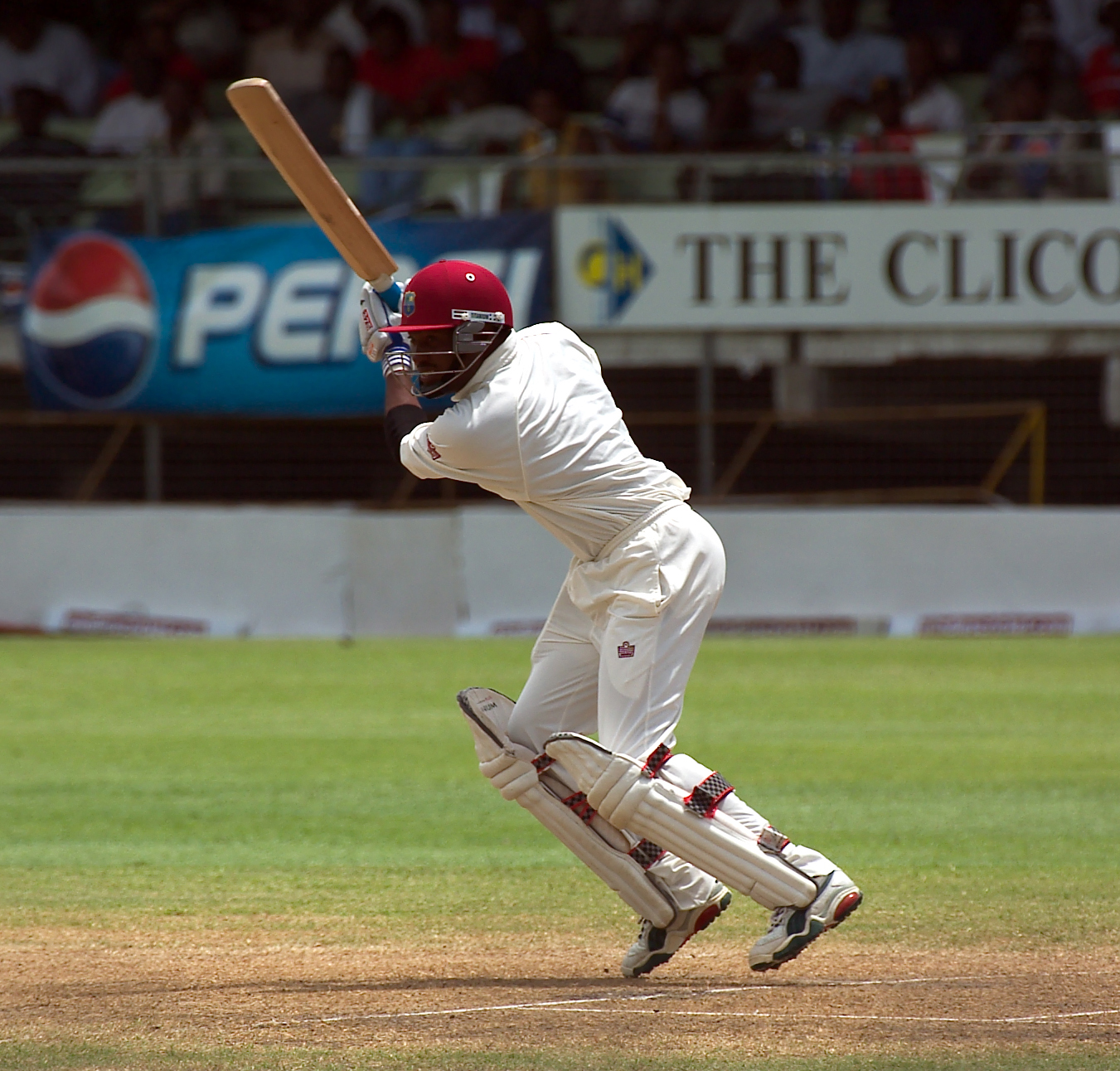
On 2 May 1969 a newborn child’s cries rang out in Santa Cruz, Trinidad and Tobago. Not an unusual event in itself but if the parents of the child, christened Brian Charles Lara, could see what was in the future for their son their pride at his birth would have been doubled.
He grew up to be one of the most celebrated cricketers of all time, topping the Test batting rankings a number of times and seizing and holding several records, including the highest individual score in first-class cricket. On that occasion in 1994 he scored an amazing 501 not out for Warwickshire. His dumbfounded opponents, Durham had to simply look on as he scored the first and only quintuple hundred in the history of first-class cricketing.
It was little surprise that as that famous day wore on fans rushed to the ground at Edgbaston to witness history being made.
He also is the holder of the record for the highest individual score in a test innings. This time he was playing against England at Antigua. The celebrated day saw him score 400 not out. Over the course of his career he scored many hundreds, but is the only batsman to do that and score a double century, a triple, a quadruple and a quintuple over the course of his career.
To add to all this, in a single over in South Africa in 2003 he scored 28 runs off Robin Peterson of South Africa. Put simply, the man was unstoppable.
Lara has his family, perhaps, to thanks for his cricketing success. As the tenth of eleven children it would not surprise many if the parents didn’t watch their second to last offspring too often, with so many in the family. Yet it was his sharp eyed father, Bunty and Agnes his older sister who spotted his potential at the age of six and enrolled him in the Harvard Coaching Clinic.
As such, Lara’s early exposure to correct batting techniques would stay with him and be developed over his lifetime. When he was a teenager he was in teams in the Trinidad schoolboy’s league. He caught the eye of the national under 16 team when his average in the league was an amazing 126 per innings, not to mention his tally of 745 runs in the league.
At the age of fifteen he played his first West Indian under 19 tournaments and the same year saw him represent his country for the first time. His heroes, Gordon Greenidge, Viv Richards and Roy Fredericks were soon to have company in that special league of their own.
1987 was a memorable year as Lara scored 498 runs in the West Indies Youth Championships – the first record of many that he was to break. The following year he made his debut for Trinidad and Tobago and scored 98 in his second first-class match. The same year saw him captain the West Indies in the Bicentennial Youth World Cup. Lara was on his way.
The following year his great opportunity presented itself – he was selected for the West Indies team (rather than the youth team) but this coincided with tragedy. His father, Bunty, died and Lara withdrew, coming back the year after to captain the B Team in Zimbabwe.
He was not to be held back again. In 1990 at the age of twenty he became the youngest ever man to captain Trinidad and Tobago. He also made his debut for the West Indies.
In 1993 his International career truly got underway when he scored 277 against Australia – his maiden test century. His efforts proved to be the turning point for the West Indies as they then went on to win the final two tests – and the series 2-1.
To commemorate this, Lara would name his first daughter after the city in which he had achieved this – Sydney.
In 1995 Lara was made Man of the Series in the test match against England. He captained the West Indies from 98 to 99 won Man of the Match against Australia as well as Man of the Series in the famous Four Test Series of 1999.
Lara was reappointed as captain against the touring Australians in 2003, and struck 110 in his first Test match back in charge, showing a return to stellar performance. Later that season, under his captaincy, West Indies won the two match Test series against Sri Lanka 1-0 with Lara making a double century in the First Test. In September 2004, West Indies won the ICC Champions Trophy in England under his captaincy.
He returned again to the captaincy of the West Indies in 2006 and led the team to victories against Zimbabwe and India. In the same year he became the first player in the team to ever pass the 10,000 run mark. He retired from international cricket in the following year.
Unable to resist it, he played again for Trinidad against Guyana – which they won. Lara’s cricket career is still happening today but what it holds for him is unsure. Whatever happens he will certainly go down in history as one of the best cricketers of all time.
The four minute mile was an elusive ambition in the field of athletics. It had been a target for many years but has never been recorded formally.
Then one day in 1954 a young man by the name of Roger Gilbert Bannister was the first person to cross this important barrier. It was a symbol of humanity’s ability to improve upon itself and he was there first. For years it had been thought an impossible barrier.
Roger Bannister was born in 1929 (and is still going strong to this day) in Harrow, a small town outside of London famous for its private boy’s school.
Bannister, however went to City of Bath Boys’ School before going on to study at University at Oxford University, followed by a tenure at St Mary’s Hospital Medical School which now forms part of Imperial in London. Little did he know then that a movie would be made about his life one day.
Like many British gentleman of his day, Bannister’s start in the world of athletics was decidedly amateur – and this is not meant in a derogatory way, At 17 he had gone down to Oxford, a promising medical career lying ahead of him. Running was a serious hobby – so the young Bannister had for example never worn running spikes before that time or indeed run on a track.
Even by the standards of 1946 his training was light. Yet he showed an enormous amount of promise and the following year he ran a mile in 4:26:6. This was with just a half hour training session three times a week. Yet why was the mile such a target, such a dream? This video, although not directly about Bannister, goes a long way to explain its allure to athletes - even today.
The British Olympics Committee was certainly impressed and he was selected as a possible in 1948. The still teenage Bannister graciously declined. He felt that he was not ready for the Olympics, choosing instead to watch them.
Over the next few years he steadily improved his timing at both the mile and the 800m (run in European Championships where a defeat in 1950 spurred him on to train much more vigorously than ever before).
His reputation of invincibility grew (mostly at home in the UK, of course) but this came crashing down in the European Championships at Belgrade in 1951 on 25 August, He lost to the Yugoslav Andrija Otenhajmer – at 3:48:4 in the 1500m. It was only 1:4 behind the other runner but it was, nevertheless, a blow.
The 1952 Olympics saw a further blow where he came fourth in the 1500m final. Yet hope remained – he had at least set a British record of 3:46.30 (3:46.0) in the process.
Bannister spent several months dwelling on his defeat and deciding whether to stay with running or to give it up entirely. After all, he had his medical career to consider and athletics made a fraction of the money that it does today. He eventually shrugged off the idea of throwing in the towel and instead set himself a new target – to be the first man to run a mile under four minutes.
He trained incredibly hard and in 1953 he made an attempt at the British record, previously held by Sydney Wooderson at 4:04.2 who had created the record eight years previously. Bannister came in at 4:03:6 – shattering the record and instilling a new hope in himself – he knew now that the four-minute mile was not out of reach.
It was not as if he didn’t have competition. Other runners had their eye on the prize too. The American Wes Santee came close on 5 June 1953 with a time of 4:02:4. Then there was the Australian John Landy who ran 4:02:0 in December of the same year. He followed this up with several new attempts in the early months of 1954 but narrowly failed to better his time.
Bannister had nervously followed his Australian rival, convinced that at each attempt the four-minute mile would be broken. At the end of the Australian season in April Bannister knew that he had a short window of opportunity – his own attempt at the record had to come soon.
The date was chosen. It would be 6 May 1954 at a meet between the British AAA and Oxford University. The Iffley Road Track in Oxford was duly prepared and 3,000 spectators turned up in anticipation. Yet the day turned out to be windswept – a 25 mile per hour wind was blowing around the track. Bannister all but pulled out but then, just before the race was due to start the winds – as if by divine ordinance, dropped. The race would go ahead.
Brasher and Chataway, running colleague had already agreed to provide the pacing for Bannister. Harold Abrahams (immortalised by his own career and the film Chariots of Fire) was there to do the commentary for the BBC Radio. Norris McWhirter who would later in his life edit and publish The Guiness Book of Records with his twin brother Ross was the stadium announcer. It was an all star cast, as it were.
Here is the race, with Roger Bannister narrating, explaining his feelings as one of the pivotal sporting events of the century progressed.
McWhirter was something of a showman. Once the race was run he teased the audience with a long preamble to the hotly anticipated result.
"Ladies and gentlemen, here is the result of event 9, the one mile: 1st, No. 41, R.G. Bannister, Amateur Athletic Association and formerly of Exeter and Merton Colleges, Oxford, with a time which is a new meeting and track record, and which - subject to ratification - will be a new English Native, British National, All-Comers, European, British Empire and World Record. The time was 3..."
There was no point at the stage in continuing. As soon as the stadium heard the magic word – 3 – it erupted with a deafening roar of triumph. Bannister's time was 3:59.04 and it was indeed a new World Record.
Of course this spurred on athletes all over the globe and it was less than two months later (46 days to be precise) that Bannister’s own record was broken. This time it was his rival, the Australian John Landy who ran 3:57:9 in Finland.
Bannister and Landy were to finally compete against each other, post record, on 7 August 1954 at the Commonwealth Games in Canada. Bannister won this epic clash of the titans, coming in at 3:58:8 with Landy less than a second behind him. Roger Bannister went on to gain a European Championship record for the metic mile (the 1500m) at Bern on 29 August – his time there was 3:43:8. Here is their miracle mile.
If it was today, Bannister would have been made for life with sponsorship deals and so on. However, for athlets 1954 was another world – if not universe and these options were simply unthought-of at that point. After Bern, Roger Bannister announced his retirement from athletics. He returned to his role as a junior doctor and pursued a successful career in neurology.
Anyone for cricket? Number 91 on our list of the top 100 sports stars is Adam Gilchrist, who otherwise goes by the nicknames of Church or Gilly. He is the first but not the last cricketer to appear but this guy is not yet retired from the game and has redefined the role of the Australian national cricket team.
Born in 1971, Glichrist is an attacking left-handed batsman but it is for his wicket keeping that he holds world records. He is the current holder of the record for the most dismissals by a wicket keeper by an Australian in test cricket and in One Day Internationals. He is generally thought to be one of the best ever wicket-keeper-batsman combinations in the history of the sport of cricket.
There is more – he is the only player ever to have hit 100 (that’s ONE HUNDRED) sixes in Test Cricket. Not only that, he has 17 Test centuries under his belt as well as 16 ODIs. As a player who was destined to be primarily a wicket keeper, that is some achievement.
He also has a unique record – the only player ever to score a minimum of fifty runs in successive World Cup finals (99, 03 and 07) and has actually won three titles – one of only three players to do so.
At the age of 17, Adam Gilchrist spent a summer with Richmond Cricket Club in London. He performed so well that he was interviewed by the regional BBC Sports Reporter, Michael Wale.
He has sometimes gone against the grain of the establishment in as much as he is a self-confessed walker. That is, occasionally he disagrees with the umpire, who says he is in – and walks off! Fair is fair, however, a player is more likely to know when they are out than the umpire yet many would make the contrary decision. Not so Gilchrist.
His first class debut was in 1992 and his first ODI (One Day International) debut followed four years later, with his Test debut in 99. He has played for his home nation in 96 test matches and getting on for 300 ODIs. In both forms he was Australia’s Vice-captain and captained the team when the regular captains were unavailable.
Here is Adam Gilchrist smashing a century in 57 balls in the Ashes 3rd test. He is the second fastest behind Viv Richards.
Although he has now retired from International cricket he still plays for the Indian Premier League with the Deccan Chargers. He was made captain in 2009 and led the team to the Twenty20 title in the same year.
It was his style of attack batting that was key to Australia’s ODI successes when he was a member of the team, and as such it was Gilchrist who invariably opened the batting. For a wicket keeper his batting average is more than reasonable – in the upper 40s in tests with a Test strike rate of 82 runs for every 100 balls and he is renowned for batting shots to every area of the field in a dynamic and consistent manner.
Outside of the sport Gilchrist serves as an ambassador for the World Vision charity in India – a country in which he is immensely popular.
So, here it is - our full list of who we judge to be the 100 Greatest Sports Stars Ever. You may not agree with the list - so feel free to make outraged comments about us leaving out your favourite sports star! If you feel strongly enough, you could always write a homage article to them which we will be happy to publish!
For an in depth look at each of these stars, click the tab at the top of the page - or this link - 100 GREATEST SPORTS STARS
100 - Andrew Johns
99 - Ian Thorpe
98 - Annika Sorenstam
97 - Chris Evert
96 - Jonah Lomuh
95 - Heather McKay
94 - Alexander Popov
93 - Shaun White
92 - Adam Gilchrist
91 - Roger Bannister
90 - Brian Lara
89 - Shirley Strickland
88 - Janet Evans
87 - Sergey Bubka
86 - George Best
85 - Ted Whitten
84 - Dawn Fraser
83 - Serge Blanco
82 - Ian Botham
81 - Usain Bolt
80 - Jackie Robinson
79 - Fanny Blankers-Koen
78 - Greg Norman
77 - Kareem Abdul-Jabbar
76 - Zinedine Zidane
75 - Bo Jackson
74 - Steffi Graf
73 - Willie Shoemaker
72 - John McEnroe
71 - Babe Zaharias
70 - Gary Ablett Sr
69 - Jean-Claude Killy
68 - Johnny Raper
67 - Arnold Palmer
66 - Sachin Tendulkar
65 - Rafael Nadal
64 - Arnold Schwarzenegger
63 - Mickey Mantle
62 - Jahangir Khan
61 - Wally Lewis
60 - Daley Thompson
59 - Wayne Carey
58 - Edwin Moses
57 - Wilt Chamberlain
56 - Joe Montana
55 - Miguel Indurain 54 - Joe Frazier 53 - Juan Manuel Fangio 52 - Jackie Joyner-Kersee 51 - Herb Elliott 50 - Zico 49 - Hicham El Guerrouj 48 - Wayne Gretzky 47 - Steve Redgrave 46 - David Campese 45 - Viv Richards 44 - Johann Cruyff 43 - Mark Spitz 42 - Michael Johnson 41 - Garfield Sobers 40 - Leigh Matthews 39 - Joe Louis 38 - Ty Cobb 37 - Haile Gebrselassie 36 - Nadia Comaneci 35 - Bobby Jones 34 - Kelly Slater 33 - Valentino Rossi 32 - Colin Meads 31 - Martina Navratilova 30 - Jerry Rice 29 - Mike Tyson 28 - Mick Doohan 27 - Pete Sampras 26 - Michael Shumacher 25 - Jim Brown 24 - Bjorn Borg 23 - Jim Thorpe 22 - Paavo Nurmi 21 - Eddy Merckx 20 - Alfredo di Stefano 19 - Jesse Owens 18 - Shane Warne 17 - Billie-Jean King 16 - Babe Ruth 15 - Sugar Ray Robinson 14 - Jack Nicklaus 13 - Emil Zatopek 12 - Ayrton Senna 11 - Michael Phelps 10 - Lance Armstrong 9 - Carl Lewis 8 - Roger Federer 7 - Pele 6 - Rod Laver 5 - Diego Maradona 4 - Tiger Woods 3 - Michael Jordan 2 - Don Bradman 1 - Muhammad Ali